
The First Bicycle |
It Was A Push Bike |
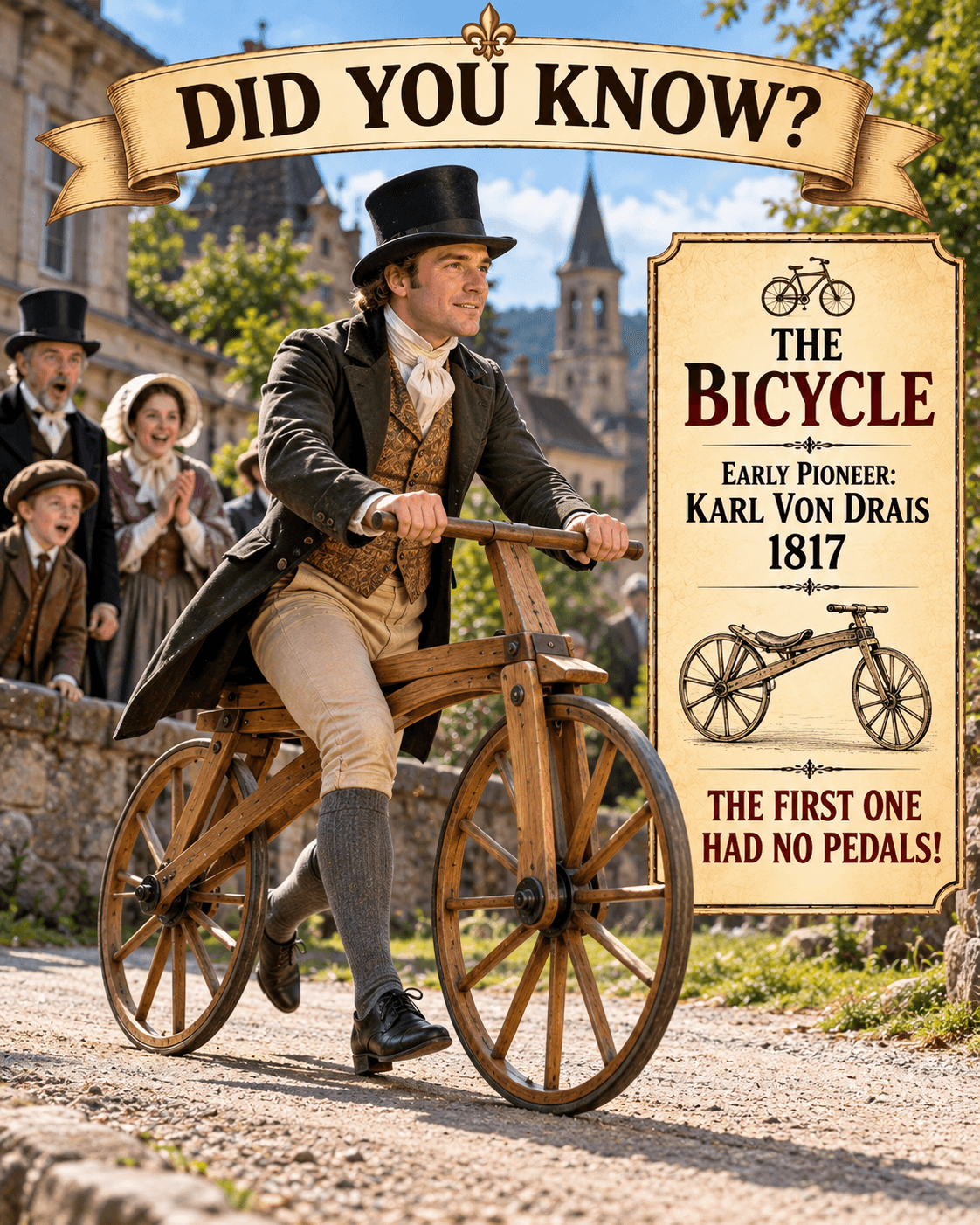
Today, bicycles are used around the world for transportation, exercise, racing and recreation. But the first bicycle-like machines were a far cry from the lightweight bikes we know today.
The story really gets rolling in 1817, when German inventor Karl von Drais demonstrated a two-wheeled machine he called a Laufmaschine, or "running machine."
It had two wheels, a wooden frame, handlebars for steering and a seat.
But there was one rather important thing missing...
It had no pedals!
So How Did You Ride It?
The rider sat on the seat and pushed against the ground with their feet—almost like today's children's balance bikes.
Once moving, the rider could lift their feet and coast.
Drais's invention became known as the draisine or dandy horse, and for a short time it became quite fashionable.
It demonstrated something important: a person really could balance and steer a vehicle with two wheels arranged one behind the other.
But the bicycle still needed a better way to move.
Along Came the Pedals
During the 1860s, pedal-driven bicycles began appearing in France. Pierre Michaux and his associates are often associated with popularizing bicycles that had pedals attached directly to the front wheel, although the exact history of who first added pedals remains debated.
These early bicycles had wooden wheels, later fitted with iron tires. They weren't exactly comfortable.
In fact, they became known as "boneshakers" because riding one over the rough roads of the day could be a bone-rattling experience.
Then Came the Giant Front Wheel
By the 1870s, the famous high-wheel bicycle, later commonly called the penny-farthing, appeared.
Its enormous front wheel allowed riders to travel farther with each turn of the pedals, making the bicycle considerably faster.
Unfortunately, sitting high above such a huge wheel also made accidents dangerous.
If the front wheel suddenly stopped, the rider could be thrown headfirst over the handlebars.
Clearly, there was still room for improvement.
The Modern Bicycle Takes ShapeThe breakthrough came during the 1880s with the development of the "safety bicycle." English inventor John Kemp Starley introduced his influential Rover Safety Bicycle in 1885.
Instead of one enormous wheel and one tiny one, it had two similarly sized wheels.
Even more importantly, the pedals drove the rear wheel through a chain.
The rider sat much lower to the ground, making the bicycle easier and safer to ride.
Then pneumatic—or air-filled—tires made bicycles much more comfortable.
By the 1890s, the bicycle had begun to look remarkably similar to the bikes we still ride today.
An Invention That Changed More Than Transportation
Bicycles gave ordinary people an inexpensive way to travel farther and more independently than they could on foot.
They also played an interesting role in social change. During the late 1800s, bicycles gave many women greater personal mobility, and prominent women's-rights advocates linked cycling with increased independence.
The bicycle even helped shape another invention.
Several pioneers of the early automobile and aviation industries began their careers working with bicycles—including Wilbur and Orville Wright, who operated a bicycle shop before building their famous airplane.
More than 200 years after Karl von Drais climbed aboard his pedal-less wooden machine, the basic idea remains remarkably successful:
Two wheels, one behind the other—and the freedom to go somewhere. Fun Fact
The ancestor of the modern bicycle was essentially a balance bike for adults.
Karl von Drais's 1817 machine had no pedals, no chain and no gears. Riders simply pushed themselves along with their feet.
|
5 Comments
Join the conversation
Didn't know the Wright brothers sold bikes
I'd never try that giant front wheel
My kid's balance bike hasn't changed much
Boneshaker is a pretty honest name
A wooden bike with no pedals sounds exhausting