
Did You Know? This Ironing Board Had an Elbow |
In 1892, dressmaker Sarah Boone patented a board shaped to follow the curves of a sleeve |
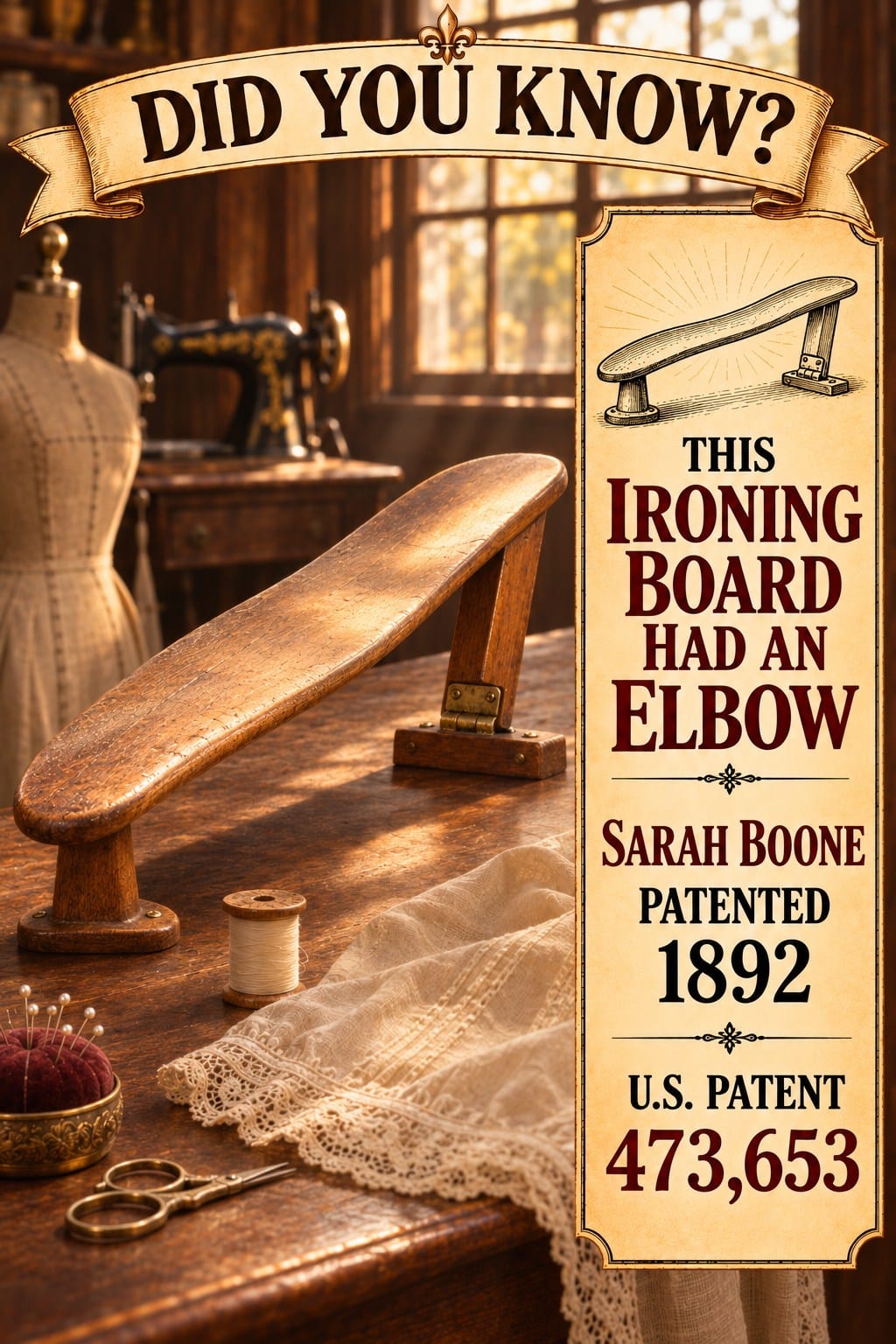
Try pressing the seam on a fitted sleeve and you’ll see the problem Sarah Boone was solving.
The sleeve curves at the elbow, but a broad, flat surface gives the fabric nowhere to go when it bunches up.
Boone, a dressmaker in New Haven, Connecticut, gave her ironing board a shape that followed the garment.
Her April 26, 1892 U.S. patent shows a narrow board with two long edges that curve in opposite directions.
One edge followed the inside seam of a sleeve and the other followed the outside seam, with the strongest curve right where the wearer’s elbow would be.
The board was slim enough to slip inside a sleeve, so the person pressing it could work along one seam at a time.
The shape was only half the idea.
For the inside seam, a hinged support swung down to steady the board.
To press the outside seam, the user turned the board over edge for edge and swung the support out of the way.
The patent drawings show both positions, making it easy to see how a single board could fit two differently shaped seams.
Boone also saw a use for the board on curved waist seams and suggested adapting its curves for men’s coat sleeves.
Reversible sleeve boards already existed, including a design patented in 1884 that attached to an ordinary ironing board.
Boone’s improvement was to pair edges shaped for the two seams with supports that let the user change positions as the work demanded.
Her patent also earned her a place in Connecticut history as the first Black woman in the state to receive a patent.
The next time you smooth a sleeve over the narrow end of an ironing board, think of the detail Boone took one step further.
She gave the board an elbow of its own, so the fabric could rest in much the same shape it would take when worn.
Sources Sarah Boone’s 1892 ironing-board patent |
0 Comments
Join the conversation
Be the first to comment
Share your thoughts above.