
Did You Know? Who Invented the Rubber Eraser? |
Before rubber cubes became a stationery staple, people used bread to rub out pencil mistakes |
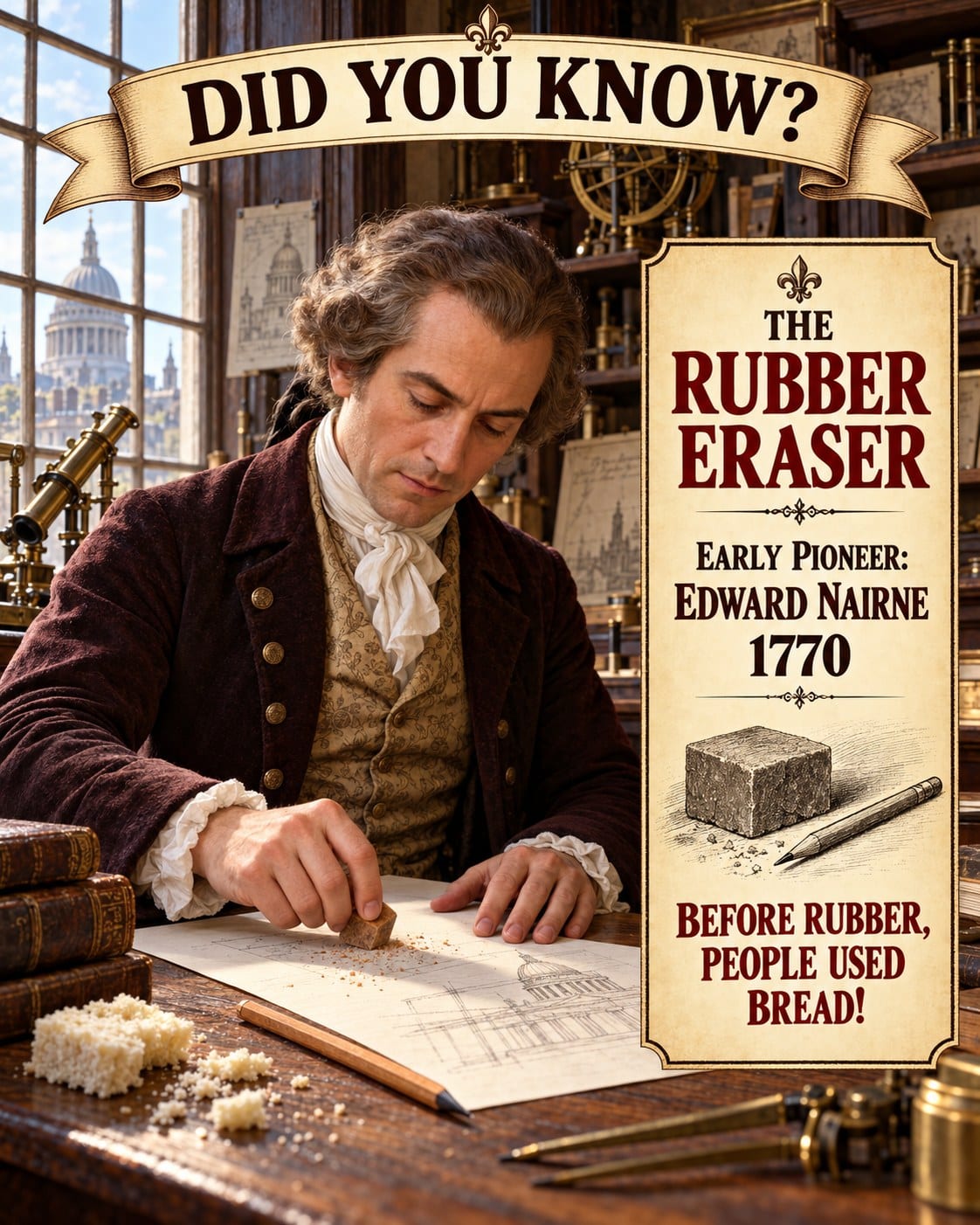
Before the rubber eraser became a pencil-case essential, people corrected pencil marks with something much more surprising: bread.
For anyone who remembers brushing eraser crumbs from a school desk, that makes the familiar little block seem positively sophisticated.
But who invented it?
The name usually associated with the early commercial rubber eraser is Edward Nairne, a London scientific-instrument maker selling the material for that purpose in 1770.
The fuller story includes another famous name, an awkward early material and a later invention that joined writing and correcting in one tool.
First, there was bread
Long before modern erasers, bread was used to lift pencil marks from paper.
It is a curious reminder that everyday problems were often solved with whatever materials people already had close at hand.
Imagine reaching for part of a loaf when a drawing needed correction, instead of the neat stationery item we expect today.
The replacement eventually came from natural rubber, a material obtained from plant latex.
The Institute of Making identifies Nairne’s 1770 eraser as an early use of natural rubber, also known as caoutchouc or gum elastic.
What the historical record tells us
Chemist Joseph Priestley described rubber’s ability to remove pencil marks in an addition to the preface of his 1770 book on perspective.
His note directed readers to Nairne’s shop opposite London’s Royal Exchange.
It also described a cube about half an inch across, sold for three shillings.
That is useful evidence of rubber erasers being offered for sale, rather than proof of one perfectly documented moment of invention.
Stories about someone accidentally picking up rubber instead of bread have been repeated in different versions.
They make an appealing anecdote, but the firmer claim is simpler: Nairne marketed the material, and Priestley recorded its usefulness.
Giving them those separate roles is more accurate than treating either man as the unquestioned sole inventor.
Early rubber needed improvement
The first rubber erasers did not have all the dependable qualities of the versions we keep in drawers today.
Natural rubber can soften in warmth, stiffen in cold and deteriorate with age.
For a tool expected to wait patiently on a desk, those are inconvenient habits.
The nineteenth-century development of vulcanization helped turn rubber into a more durable and useful material.
Charles Goodyear’s work with heat and sulphur in 1839 was an important step in that wider change.
Improving the material helped make rubber suitable for many practical products, not simply for rubbing out a troublesome pencil line.
Then the pencil gained a partner
Another milestone arrived on March 30, 1858, when Hymen L. Lipman received a United States patent for a combined pencil and eraser.
His design placed prepared rubber inside part of the wooden pencil holder, with graphite occupying the other portion.
Sharpening one end exposed the writing material, while cutting the opposite end exposed the eraser.
It was a more specific construction than simply attaching today’s familiar pink cap and metal band to a pencil.
The patent explained the practical advantage: the erasing material would be less easily soiled or misplaced on the desk.
For people working on detailed drawings, the rubber could also be shaped into a fine point.
A small tool with a long story
Today’s erasers come in different materials and forms, including varieties designed for artists and different kinds of marks.
The everyday eraser therefore represents a chain of observations, material improvements and design choices.
Nairne remains a key name in its early commercial history, but he is part of a longer story of people finding better ways to correct their work.
The next time you rub out a pencil mistake, remember how much ingenuity can fit into a small piece of stationery.
And be glad your pencil case does not need a slice of bread. |
2 Comments
Join the conversation
Interesting that Priestley just mentioned it in a book preface. Not exactly a big announcement for such a useful thing.
Never knew bread was used before erasers. That genuinely surprised me.