
The 200-Year-Old Invention Still in Your Pantry |
But How Did They Open It? |
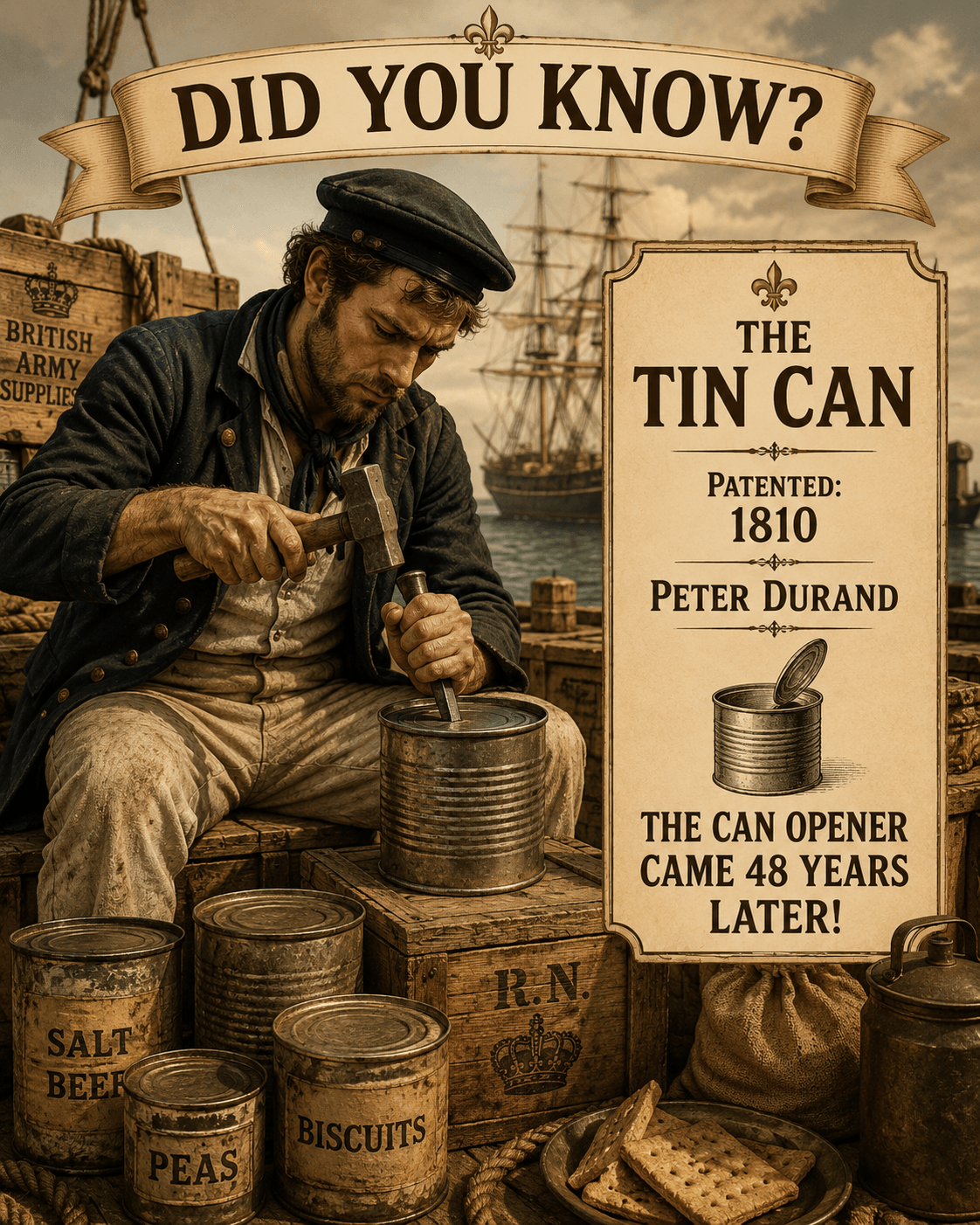
Did You Know? Who Invented the Tin Can?
Today we open a can of soup or vegetables without giving it a second thought. But more than 200 years ago, preserving food for long periods was a major challenge—especially for armies and sailors travelling far from home.
The story of the tin can begins with Napoleon Bonaparte.
In the late 1700s, Napoleon's government offered a substantial reward to anyone who could develop a reliable method of preserving food for French troops.
French confectioner Nicolas Appert discovered that food could be preserved by placing it in sealed glass bottles and heating them. His method worked remarkably well and earned him the government prize in 1810.
But glass bottles had an obvious problem: they were heavy and easily broken.
Along Came the Tin Can
That same year, 1810, English merchant Peter Durand received a British patent for preserving food in containers made from tin-plated iron.
The containers were stronger than glass, easier to transport and much better suited to ships and military expeditions.
Durand didn't build a huge canning business himself. His patent was later acquired by Bryan Donkin and John Hall, who established one of Britain's first commercial canning operations.
By 1813, they were supplying canned foods to the British Army and Royal Navy.
There was just one rather important problem... They Forgot the Can Opener!
Early cans were made from extremely thick metal—far heavier than the thin cans we know today.
And the can opener hadn't been invented yet.
Instructions on some early cans reportedly told customers to "cut round the top near the outer edge with a chisel and hammer."
Soldiers and sailors also resorted to knives, bayonets and whatever other tools happened to be available.
It wasn't until 1858—almost 50 years after the tin can was patented—that Ezra Warner patented a dedicated can opener in the United States.
As manufacturing improved, cans became thinner, lighter and much easier to open.
An Invention That Changed the Way We Eat
Canned food transformed how people could store and transport food.
Ships could undertake longer voyages. Armies could carry dependable food supplies. Eventually, ordinary families could keep meat, fruit and vegetables for long periods without refrigeration.
More than two centuries later, canned foods remain a staple in kitchens around the world.
And it all started with a simple problem:
How do you make food last longer?
The answer changed food forever.
Fun Fact:
The tin can came before the can opener by nearly half a century.
Imagine buying canned food and then discovering you needed a hammer and chisel just to get your dinner out! |
9 Comments
Join the conversation
Just picturing a kitchen with bayonets and chisels next to the pots. What a time!
It’s wild that ships and armies started using canned foods so fast. Makes sense once you think about it.
Always thought the can and the opener were invented together. Whoops.
Cool info! My grandpa used to tell us stories about opening old cans with his pocketknife. Guess things haven’t changed much.
Thank you Nicolas Appert and Peter Durand! My pantry would be very empty without canned soup.
Makes me wonder how many people cut themselves opening old cans back then.
Napoleon being involved is kinda surprising, actually. History pops up in weird places.
Can’t imagine having to use a hammer just to eat some beans. We’ve got it easy now.
I never knew the can opener came so much later! That would have been annoying.