
Who Invented the Wheelbarrow? |
One Wheel That Changed the Way We Carry Everything |
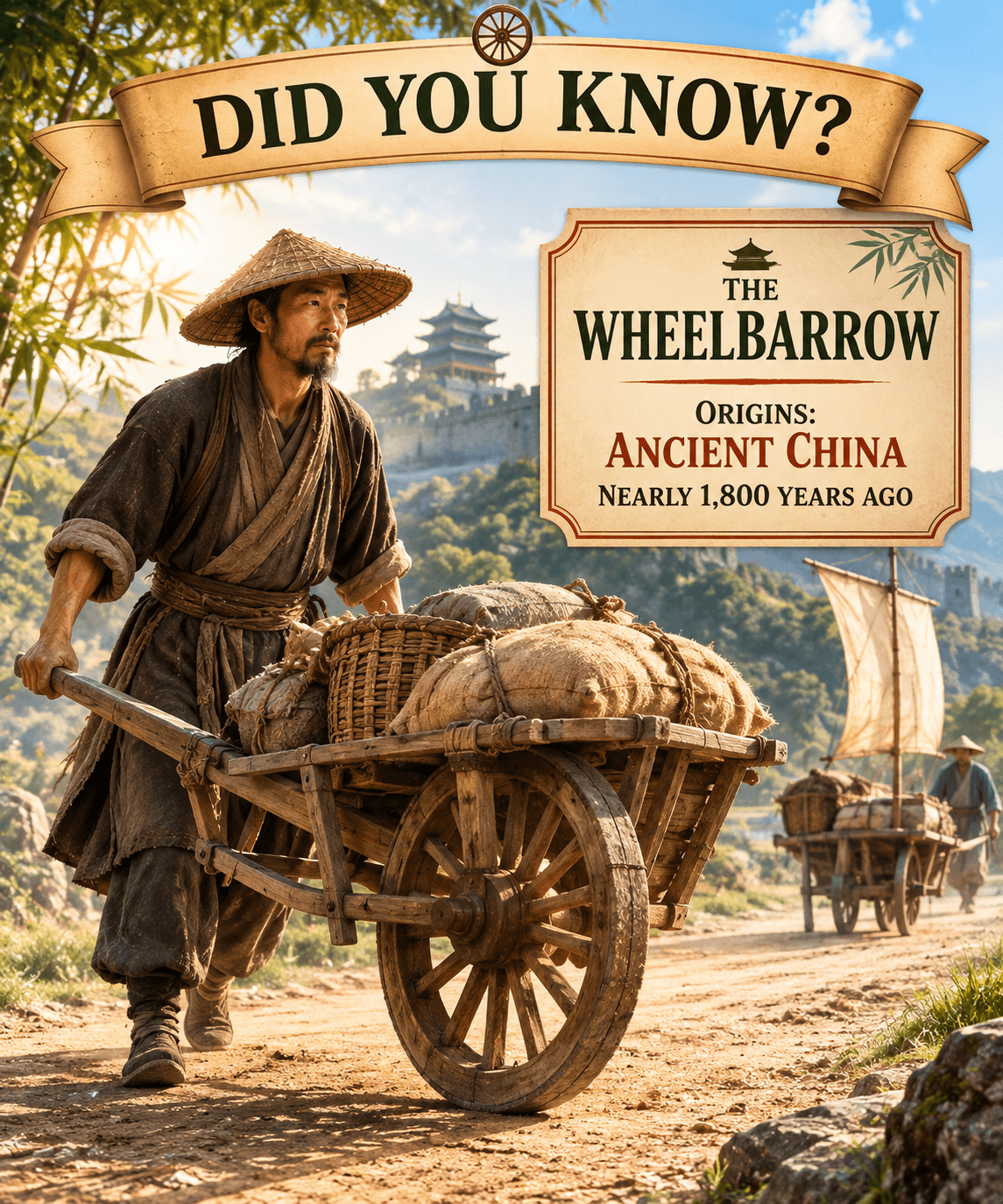
It may look like one of the simplest tools ever made—a wheel, two handles and a box—but the humble wheelbarrow was an invention that dramatically changed the way people moved heavy loads.
And its story begins in ancient China.
The earliest solid evidence of wheelbarrows comes from China during the Han Dynasty, with tomb paintings and reliefs from around the 2nd century AD showing wheelbarrow-like carts being used to transport goods.
Chinese tradition also associates the invention with the famous military strategist Zhuge Liang, who lived from AD 181 to 234. According to later accounts, he used a device sometimes called the "wooden ox" to transport military supplies.
However, wheelbarrow-like vehicles appear in Chinese artwork from before Zhuge Liang's time, so historians generally don't consider him the original inventor.
What Made the Chinese Wheelbarrow Different?
Many early Chinese wheelbarrows had their large wheel positioned near the centre of the load.
This was remarkably clever.
Instead of the person carrying much of the weight with their arms, the central wheel supported a large portion of the load. That meant a single person could move surprisingly heavy cargo . Wheelbarrows were used to carry food, building materials, farm produce, military supplies and even people
Some later Chinese wheelbarrows were so large that passengers could sit on either side of the wheel.
The Wheelbarrow Reaches Europe
The wheelbarrow seems to have appeared independently in medieval Europe by around the 12th or 13th century.
European designs were somewhat different.
Instead of placing the wheel beneath the centre of the load, Europeans generally positioned a smaller wheel at the front, with the operator lifting the handles at the back.
That basic design should look very familiar—because it is essentially the wheelbarrow still sitting in gardens, farms and construction sites today.
One Wheel, A Huge Difference
The brilliance of the wheelbarrow isn't complicated machinery. It's the way the wheel and handles work together.
The wheel carries much of the load while the handles give the operator leverage, allowing one person to move materials that might otherwise require several people.
Nearly two thousand years after the earliest known examples appeared, we are still using essentially the same idea.
Sometimes the simplest inventions really are the ones that last.
Fun Fact:
Some Chinese wheelbarrows became known as "sailing carriages" because they were fitted with sails!
With the wind behind them, the sail could help propel the heavily loaded wheelbarrow along the road, reducing the amount of effort required from the person pushing it. |
11 Comments
Join the conversation
Cool info. Makes me appreciate mine more, even if the tire is always flat
Had no idea wheelbarrows started in China. Cool history!
Anyone ever tried adding a sail to theirs? Lol might help me haul firewood up my driveway
The central wheel design makes total sense. Surprised it didn't catch on here
Zhuge Liang gets credit for everything! Cool but I like that the invention might be older
I always wondered why my arms get so tired with my garden one. We need the wheel in the middle like the old Chinese ones!
Is there anywhere you can see those ancient wheelbarrows? Would love to see how big they got
It’s neat how something so simple stuck around for centuries. Sometimes you don’t need tech
Had no idea they were that old. Honestly, still so useful today. Used mine yesterday for mulch
Sailing carriages?? That sounds fun, I want to see one in action
never knew wheelbarrows started in China, that's wild