
The Accidental Invention That Put Fire in Your Pocket |
One Scratch—and the World Had Instant Fire |
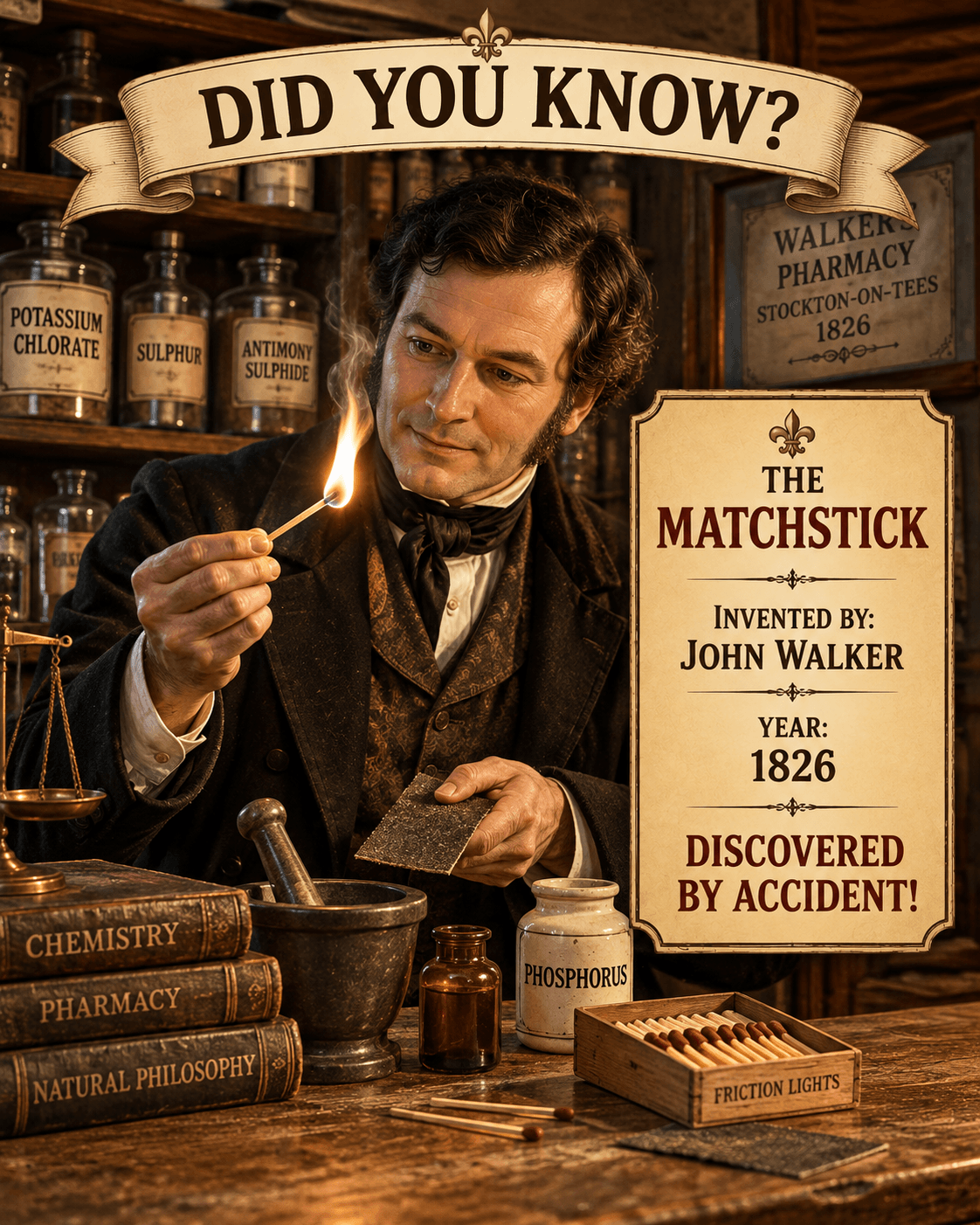
For thousands of years, starting a fire wasn't as easy as striking a match. People relied on flint and steel, glowing embers, and other cumbersome methods to produce a flame.
That began to change in the early 1800s.
The first practical friction match is generally credited to English chemist and pharmacist John Walker, who discovered it almost by accident in 1826.
An Accidental Discovery
Walker was experimenting with chemical mixtures in his pharmacy in Stockton-on-Tees, England. He had been stirring a mixture containing chemicals including potassium chlorate and antimony sulfide with a wooden stick.
Some of the mixture dried on the end of the stick.
When Walker scraped the stick across a rough surface to remove it, something unexpected happened:
It burst into flame!
Walker immediately realized that his accidental discovery could provide a simple new way of starting fires.
By 1827, he was selling his matches to customers.
They Weren't Exactly Pocket-Sized
Walker's early matches were quite different from today's little wooden matches. They were several inches long and came packaged with a piece of folded sandpaper for striking them.
He called them "Friction Lights," although they also became known as "Lucifers."
They worked—but they weren't particularly pleasant.
Early matches could ignite violently, throw sparks and produce a strong, unpleasant smell.
Still, the idea was revolutionary.
For the first time, an ordinary person could produce fire almost instantly simply by rubbing a chemically coated stick against a rough surface.
Walker Never Patented His Invention
Perhaps the most surprising part of the story is that John Walker never patented the friction match.
Other manufacturers quickly copied and improved upon his invention, and match production became a major industry.
Unfortunately, some later matches contained white phosphorus, a highly toxic substance that caused terrible illnesses among workers in match factories.
Eventually, safer formulas were developed using red phosphorus and other chemicals.
The modern safety match separates some of the necessary chemicals between the match head and the striking surface. That's why a safety match normally ignites only when rubbed against the special strip on its box.
A Tiny Invention That Changed Everyday Life
It is difficult today to appreciate just how important the matchstick once was.
Before electric stoves, central heating and electric lighting, families needed fire every day for cooking, warmth, candles and lamps. The ability to create that fire with one quick strike was a remarkable convenience.
Nearly 200 years after John Walker's accidental discovery, the humble match remains one of the simplest and most recognizable inventions in the world.
Fun Fact
John Walker's first friction matches reportedly sold in small boxes containing 50 matches, along with a folded piece of sandpaper for striking them.
And despite creating an invention used around the world, Walker made little fortune from it because he never patented his idea. |
5 Comments
Join the conversation
Those early matches sound scary! Sparks and bad smells, yikes.
Funny how he never patented it. Bet he could’ve made a fortune.
Imagine being the first person to see a stick catch fire like that. I would freak out!
I had no idea matches were accidentally invented. Makes you wonder how many other things happened that way.
It’s wild that matches used to be called Lucifers. Sounds so dramatic.