
Beck Antiques Presents |
"The Story Behind It" with Clinton Beck |
 |
The Magic of the 16mm Projector
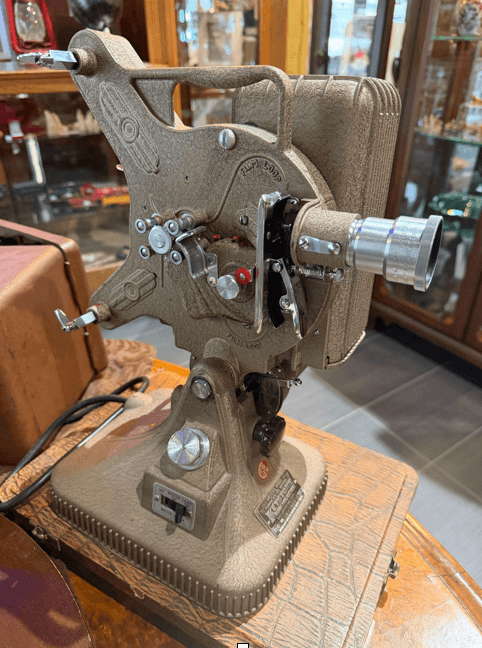
Today, we can watch a movie instantly on a phone, tablet, or television. Yet for much of the twentieth century, bringing moving pictures into a home, school, or community hall required a remarkable machine like this Keystone Model K-160 16mm projector.
Manufactured in Boston, Massachusetts, Keystone projectors became a familiar sight throughout North America during the 1930s, 1940s, and 1950s. Built from heavy cast metal and designed for reliability, these machines were used to show educational films in classrooms, training films for businesses and the military, religious programs in churches, and family movies in living rooms.
The 16mm film format was introduced by Eastman Kodak in 1923 as a safer and more affordable alternative to the highly flammable 35mm film used in commercial theatres. This innovation made motion pictures accessible to schools, clubs, and ordinary families for the first time.
Operating a projector required a bit of skill. Film had to be carefully threaded through a series of guides and sprockets before passing in front of a powerful lamp. As the reel spun, thousands of individual images flashed across the screen each minute, creating the illusion of motion. To audiences of the day, the experience could feel almost magical.
These projectors also played an important role in preserving community memories. Many family celebrations, vacations, weddings, and local events were recorded on 16mm film and shown to friends and neighbours using machines just like this one. |
13 Comments
Join the conversation
Bring back movie nights with real projectors! Would go for sure.
Honestly, threading the film was the scariest part in school. Always afraid I’d break it.
Boston made, huh? Didn't know local companies had such an impact.
I wish schools kept a few of these around for special movie days.
Funny how these machines outlasted so many new gadgets. Solid stuff.
The sound of the projector running was half the experience.
Feels like everything is so easy now. Had to work to watch a movie back then!
My uncle filmed our family reunion in 1962 with one of these! Still have the reels.
Wow, had no idea 16mm films made things safer for folks back then. Learned something new.
Wish we could experience that magic again, not just everything on a screen.
I remember how easy it was to mess up the threading. Oops.
My dad still has his old projector in the attic! Never knew it was so special.
We used to watch nature films on these in elementary school. Brought back some memories.