
Who Invented the Fountain Pen? |
An early idea. A lasting impression. |
Imagine writing a letter and having to stop every few words to dip your pen into an inkwell.
Before fountain pens became common, that interruption was part of everyday writing.
A pen that carried its own ink offered a welcome change—but who deserves the credit?
The answer involves more than one inventor. The fountain pen developed through a series of designs and improvements, rather than appearing fully formed in one person’s workshop.
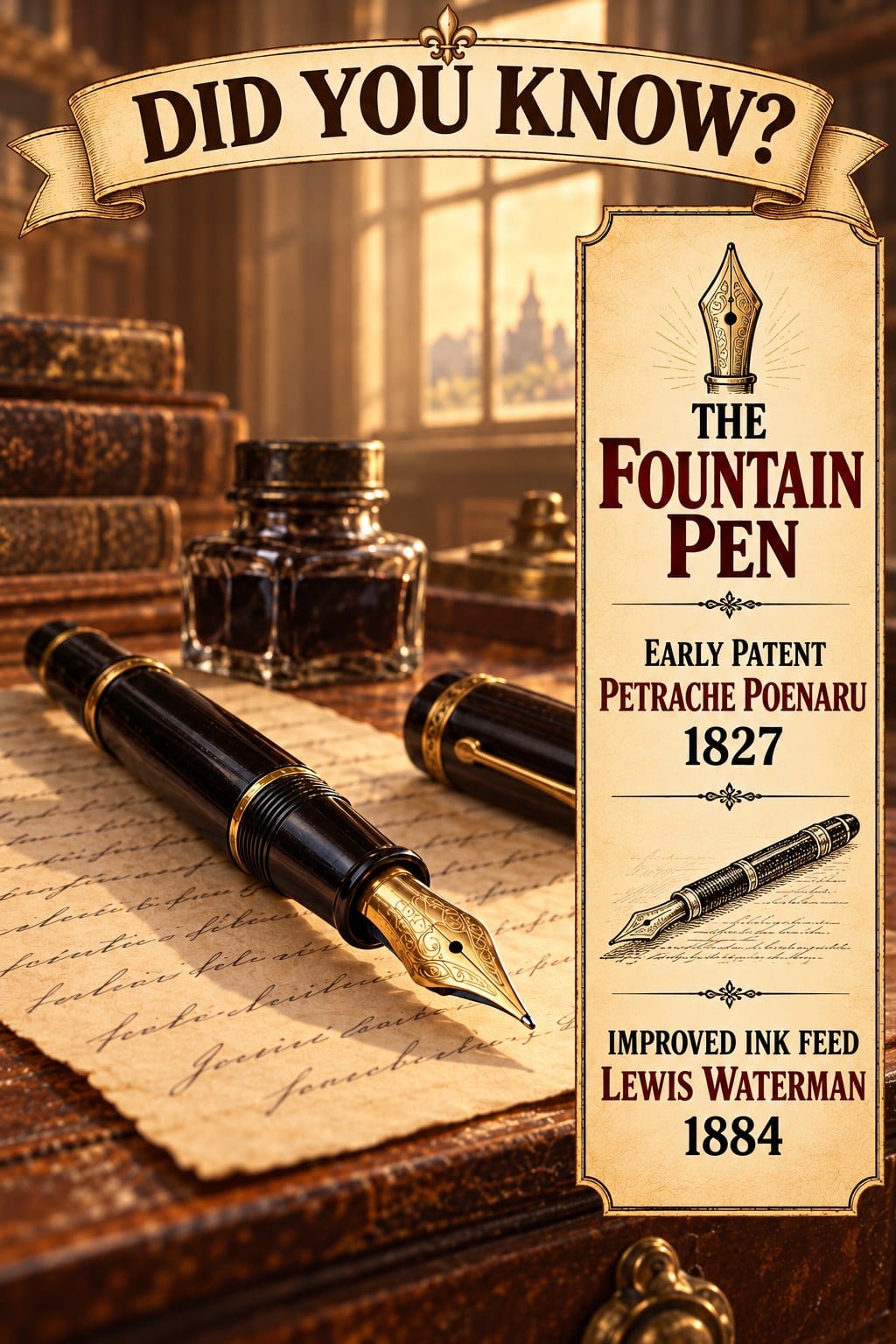
One important name is Petrache Poenaru, a Romanian inventor who received a French patent on May 25, 1827, for an early fountain pen.
His design used a swan’s quill as an ink reservoir, allowing the writer to carry a supply of ink inside the instrument.
It was a clever step toward freeing people from the constant need to dip their pens.
Still, carrying ink was only part of the challenge.
A useful pen also had to release it steadily.
Too little ink interrupted the writing; too much could leave an unwelcome blot on the page.
Decades later, Lewis Edson Waterman helped address that problem.
In the early 1880s, he developed an improved feed—the small component that delivers ink to the writing tip, or nib.
His three-fissure design allowed ink and air to move in opposite directions, helping control the ink supply.
Waterman received his first pen-related patent in 1884 and established the Waterman Pen Company that year.
Think of the difference this made to someone writing a long letter.
Instead of repeatedly reaching for an inkwell, the writer could keep moving across the page.
The innovation was about more than convenience: it helped turn a promising idea into a more dependable writing tool.
So, who invented the fountain pen? Poenaru deserves recognition for his early patented design, while Waterman deserves credit for an important improvement that helped make fountain pens practical.
Giving either man sole credit would leave out part of the story.
The next time you see a fountain pen, imagine the patience behind its development.
That elegant nib represents generations of people trying to solve a surprisingly tricky problem: getting just the right amount of ink onto paper. |
0 Comments
Join the conversation
Be the first to comment
Share your thoughts above.